
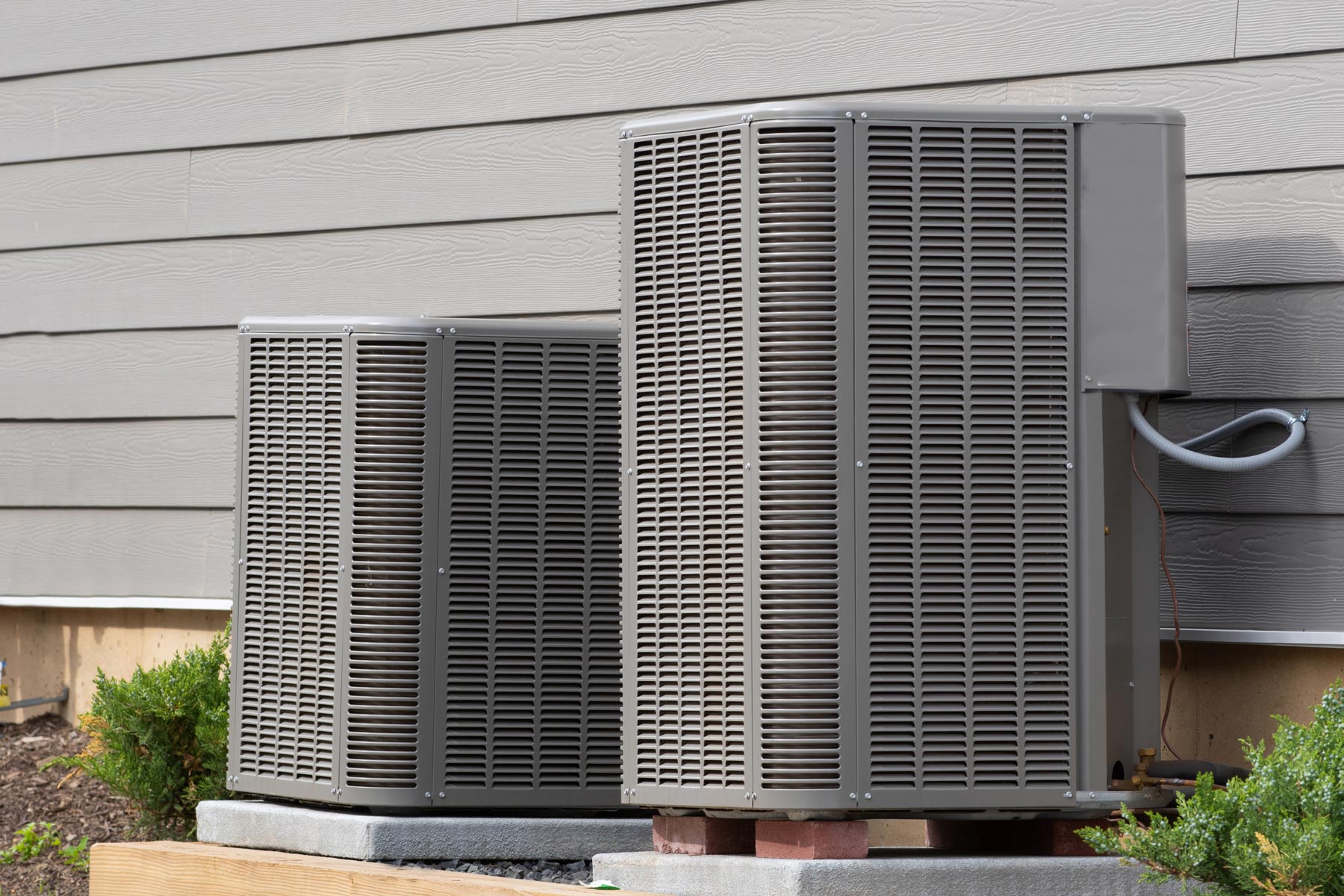
An air conditioner that quits on a July afternoon in Hampton Roads gets noticed fast. Before you do, a few minutes at the thermostat, the breaker panel, and the outdoor unit are worth your time. A fair share of no-cooling calls turn out to be something you could have reset yourself. Find your symptom below and run the checks, and you will either have your cooling back or a clear sense of what the technician will look for.
Checks to run first, whatever the symptom
- Confirm the thermostat is set to cool, the set point is below the room temperature, and the fan is on auto rather than on, since a fan running constantly blows unconditioned air between cycles.
- Look at the filter, because a clogged one starves the system of air and causes several of the problems below.
- Check the breakers for the air conditioner and the air handler, resetting a tripped one once. If it trips again, leave it off and give us a call, since our electricians can trace the fault on the same visit.
- Make sure the outdoor unit is clear of grass clippings, leaves, and shrubs, and rinse off the salt film that coastal air leaves on the coil over a summer.
- Check that the disconnect box on the wall near the outdoor unit is in place, since it sometimes gets pulled during yard work.
It runs, but the air is not cold
If the checks above did not help, the usual causes are a low refrigerant charge from a leak, a dirty indoor or outdoor coil, a failing compressor, or a duct that has come apart in the attic and is pouring cooled air into 130-degree space. Each is something we measure rather than guess at, since refrigerant pressures, coil condition, and duct pressure tell the story in minutes.
Nothing happens at all
A dead system is often a power problem rather than an equipment problem, which is why the breakers and disconnect are on the list above. If those check out, look at the indoor unit for a float switch, the small device on the condensate line that shuts the system off when the drain backs up. If there is water in the drain pan, that switch is the reason the system is off, and clearing the drain brings it back. Beyond that, a dead system points to a failed capacitor, contactor, transformer, or control board, and each is a routine air conditioning repair.
The outdoor unit hums or clicks, but the fan does not turn
A humming unit with a still fan is almost always a failed capacitor, the small cylinder that gives the motors their starting push, and salt air wears capacitors and contactors faster here than inland. Please do not try to start the fan by hand, because the compressor is straining against the same weak part and can be damaged if it keeps trying. Switch the system off at the thermostat to spare the compressor, and give us a call. A loud click that repeats without a start is usually the contactor, and both parts are inexpensive right up until they take the compressor with them.
There is ice on the lines or the indoor coil
Ice on a cooling system in July always means the indoor coil got cold enough to freeze the moisture in the air, and restricted airflow from a dirty filter or a low refrigerant charge are the two usual reasons. Shut the system off and give the ice several hours to melt completely, then put in a fresh filter and try again. If the ice returns, the cause is refrigerant or the coil and needs a technician, and running an iced system pushes liquid refrigerant into the compressor.
There is water around the indoor unit
Air conditioning wrings gallons of water out of coastal air every day, and all of it leaves through a narrow condensate line that clogs with algae across a wet season. Water in the pan, water on the floor, or a stain on the ceiling beneath an attic unit means the line is blocked or the pan is cracked. If the system is still running, please shut it down before the water finds the ceiling. Clearing the line is a routine service item, and adding a float switch, if the system does not have one, keeps the next clog from becoming a drywall repair.
It runs all afternoon and never catches up
On a 95-degree afternoon with the heat index over 100, an air conditioner running without pause is not necessarily broken, since systems here are sized for the low 90s and above that they run continuously and hold the house a few degrees above the set point. That is normal behavior, and lowering the thermostat will not change it. A system that runs all day on an 85-degree afternoon, or cannot get the house below 80, is a different matter and points to low refrigerant, dirty coils, a leaking duct, a failing compressor, or a system that was undersized from the start.
New noises or smells
Grinding or squealing points to a motor bearing on its way out. Banging or rattling generally means a part inside a unit has worked loose or broken. Hissing or bubbling near the refrigerant lines means refrigerant is escaping. A musty smell at startup is growth on the indoor coil or in the drain pan, and a burning or electrical smell means shutting the system off at the breaker and reaching out that day.
Getting the cooling back
Russell’s American Mechanical has served Hampton Roads since 1977. If the checks above did not bring the cooling back, schedule online, use the website chat, or call, and same-day appointments are available by phone when the day allows. The technician will find the cause, explain it, and lay out the repair options at everyday pricing before any work begins, and members of the Premium Home Care Agreement receive priority response when a covered system fails.