
If you have been in your Hampton Roads home for a couple of decades, its systems have been growing older alongside you, in salt air. The heat pump that was new when the kids were small is now fifteen, and the water heater that replaced the one Isabel took out is well past ten. The panel has been carrying more every year without anyone opening it. Nothing has failed outright, which is why nobody has looked closely. This post covers the inspections that show where each system stands and what each finds. It then covers how to turn the results into a plan that runs on your schedule.
Begin with the ages
Before scheduling anything, spend a few minutes reading labels and jot each date beside the system’s typical lifespan.
- Heating and cooling: the nameplate on the outdoor unit carries a manufacture date or a serial number that encodes one, and heat pumps and air conditioners last 12 to 15 years in coastal air, gas furnaces 15 to 20, and boilers 20 or more.
- Water heater: the label on the tank gives the date. Tank heaters run 8 to 12 years, tankless units about 20.
- Electrical panel: the date is often printed inside the door, and panels serve 25 to 40 years while breakers wear with every trip.
- Generator: the controller shows hours run and often the install date, and a serviced unit lasts 20 to 30 years.
Whatever sits near the top of its range belongs on the list below.
Heating and cooling evaluation
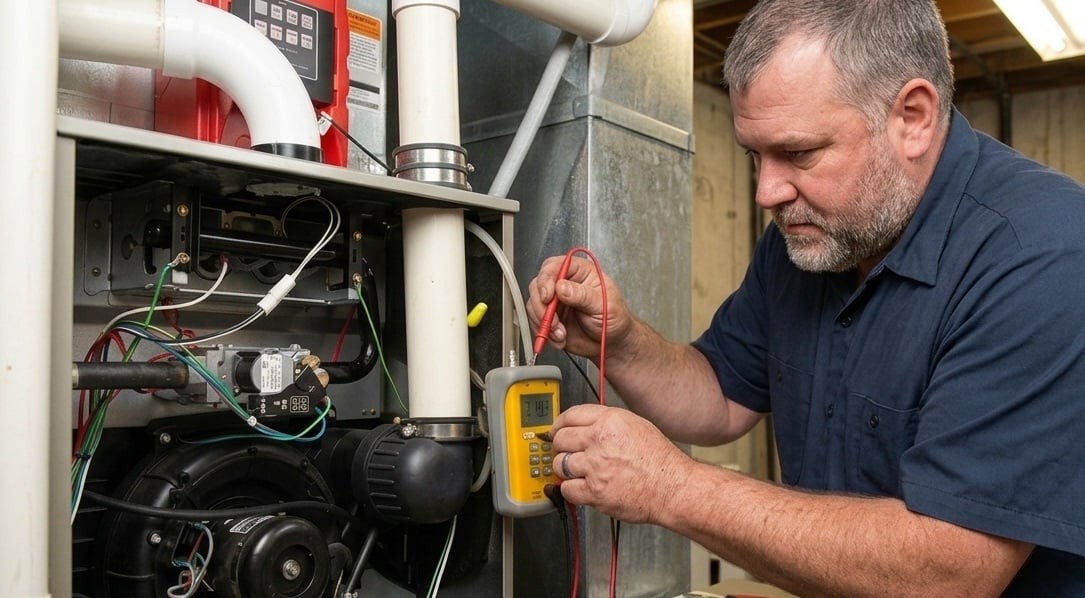
Evaluating an older system takes more than a tune-up. The technician measures refrigerant pressures and temperatures to judge the compressor’s health, tests the capacitor and motors under load, measures airflow, checks the outdoor connections for salt corrosion, and on gas equipment inspects the heat exchanger for cracks. You come away knowing how much life the system has left and what keeping it running costs against replacing it. In a home that has kept up with maintenance, that picture is usually reassuring; in one that has not, the replacement decision is often nearer than expected, and October is a more convenient month to learn that than July.
Plumbing assessment
Plumbing usually ages without much attention, and a home lived in for decades holds lines, valves, and drains that went in once and have seldom been seen since. The assessment measures pressure at the main and the fixtures, identifies the pipe material, tests every shutoff valve, checks each drain’s flow, and inspects the crawl space for the standing water and corroded fittings the high water table encourages. For homes built between the late 1970s and the mid 1990s, the technician looks specifically for polybutylene, a gray plastic supply pipe that fails with age and that many insurers will not cover. Where drains clog repeatedly, a camera inspection shows roots, cracks, and separated joints before the line fails.
Water heater check
The water heater fails without warning and does the most damage in a garage that floods or a damp crawl space. An inspection checks the age, flushes sediment, tests the relief valve, checks the anode rod, and looks for moisture at the base. For a heater past ten years, the useful outcome is a plain answer about whether to replace it now or plan for it within a year or two, and whether a tankless unit suits a household whose needs have changed.
Electrical inspection
The electrical system is the one long-time owners have most often never had inspected, and here it is the one the years are hardest on. Salt air corrodes the meter base and every outdoor connection, panels in garages may have taken water in a nor’easter, and many homes across Norfolk, Portsmouth, and older Chesapeake carry 100-amp service or older wiring under loads that have grown with every appliance added since. An electrical inspection opens the panel and checks the breakers, bus bars, and connections for heat, corrosion, and looseness, then covers the grounding, the GFCI protection, the outdoor connections, and a sample of outlets. What you get is a clear separation between what needs attention soon, what is a capacity limit waiting for the next large appliance, and what is old but sound.
Generator checkup
A standby generator a decade or more old has a transfer switch with thousands of operations behind it, an enclosure that salt has been working on, and an engine that has run through several long outages. During generator service, a checkup reads the fault history, tests the battery under load, checks fuel pressure, changes the oil and filters, inspects the enclosure for corrosion and pests, and runs the unit under full load, and the technician can say whether the unit is still sized for a home whose heat pump may have been replaced since.
Turning the results into a plan
Looking at everything at once produces something no single repair call does, which is a plan. With every system’s age and condition on paper, you can see which replacement is coming first, which repairs are worth making, and roughly what to set aside each year. Either way, the decisions rest on numbers rather than on a crisis, and for a home you plan to stay in, a few appointments are a small price for that.
Scheduling the inspections
Russell’s American Mechanical has served Hampton Roads since 1977, and many of the homes we visit today we first visited decades ago. If your systems are approaching the ages above, schedule online, use the website chat, or call. Members of the Premium Home Care Agreement receive the heating and cooling visits and the plumbing and electrical inspections as part of the plan, and every homeowner receives a plain account of where each system stands, at everyday pricing.