
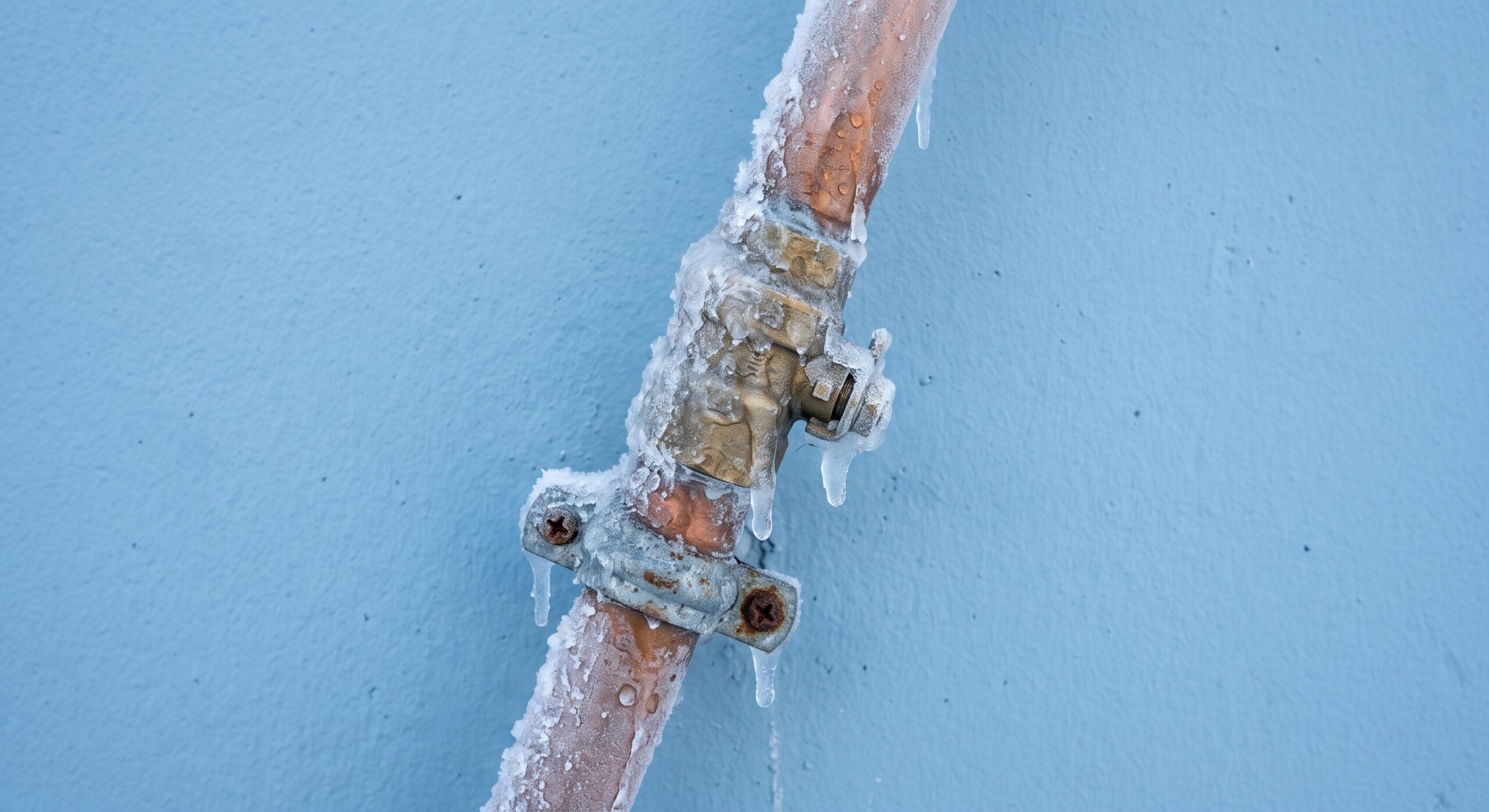
Frozen pipes are not something most people in Hampton Roads spend much time thinking about, and that is understandable. The winters here are mild enough that pipes rarely get insulated in the first place. They are also just cold enough, on a handful of nights each year, to split the ones that were not. A burst pipe is one of the more stressful things a home can hand you. The good part is that the pipes at risk sit in predictable places, and protecting them takes an afternoon in the fall and a few small habits on cold nights. This post walks through all of it, including what to do if a pipe freezes anyway.
Why pipes split
Water takes up more room as ice than as liquid. Inside a closed pipe, ice forms at the coldest point and traps the water between itself and a closed faucet, and as the ice grows, the pressure on that trapped water climbs until a fitting or the pipe wall lets go. The split usually happens a little downstream of the ice itself, and the leak often stays hidden until things thaw, which is why so many burst pipes turn up the afternoon after a freeze rather than during it. That is also why the habits below are about relieving pressure as much as adding warmth.
Where Hampton Roads homes are vulnerable
The pipes that freeze here sit in a few familiar places, and knowing them is a good part of the work. Outdoor spigots and outdoor showers go first, along with the short run of pipe just behind them. Supply lines in the crawl space come next, and because the high water table keeps so many crawl spaces here damp, the cold has an easier time of it. Pipes in exterior walls, including the ones behind kitchen and bathroom sinks that sit on an outside wall, freeze when the cabinet doors stay closed and block the warm room air. Garages with a water heater or a laundry hookup, attic lines, the pipe that feeds an irrigation backflow preventer, and lines out to a dock or a pool house round out the list. If your home is on a well, as many are in the rural parts of Chesapeake and Suffolk, the line from the well head and the lines inside the well house belong on it too.
What to do once each fall
- Take the hoses off and drain them, fit insulated covers on the spigots, and shut off and drain the outdoor shower if you have one.
- Cover every exposed pipe in the crawl space, garage, and attic with foam pipe insulation, which is inexpensive and slips on in minutes.
- Close the foundation vents and seal the gaps around pipe penetrations and the sill so cold air is not moving directly across the lines.
- Turn off and drain the irrigation system.
- If you have a well, check that the heat lamp or the insulation in the well house is doing its job.
What to do on the night of a hard freeze
- Open the cabinet doors under any sink that sits on an exterior wall so the room’s heat can reach the pipes.
- Hold the thermostat at 55 degrees or above overnight, even when nobody is home.
- Leave a faucet at the far end of the house dripping slowly. Moving water resists freezing, and the open faucet relieves the pressure that splits a pipe.
- If you are leaving town during a cold stretch, shut off the main water valve and open a faucet to drain the pressure from the lines before you go.
If a pipe freezes
A frozen pipe usually shows up as a faucet that gives you a trickle or nothing at all, sometimes with frost on the visible section of pipe. Leave that faucet open, and then warm the frozen section slowly with a hair dryer, a heating pad, or towels soaked in hot water, working from the faucet back toward the ice. A torch or any open flame should never touch a pipe. As the ice melts, the water will begin to move again, and the open faucet gives it somewhere to go.
If a pipe has burst
The first thing to do is close the main shutoff valve, and then open a few faucets to drain the lines. After that, give us a call and we will get someone out for frozen and burst pipe repair. The technician will find the break, replace the damaged section, and check the rest of the run, because a hard freeze rarely damages just one spot. If your home has older galvanized steel lines, or polybutylene, a gray plastic pipe used from the late 1970s into the mid 1990s, you may find the same places freezing and failing winter after winter. When that pattern sets in, repiping the vulnerable runs usually costs less over a few years than repairing them one freeze at a time, and the technician will explain both paths rather than steer you toward either.
We are here when it happens
Russell’s American Mechanical has served Hampton Roads since 1977. If you hear water running behind a wall or see a wet ceiling after a freeze, shut off the main valve and call us; same-day appointments are available by phone when the day allows, and after hours our answering service takes the call so we can reach you first thing. You can also schedule online or through the website chat, and members of the Premium Home Care Agreement receive priority response when a covered system fails.
