
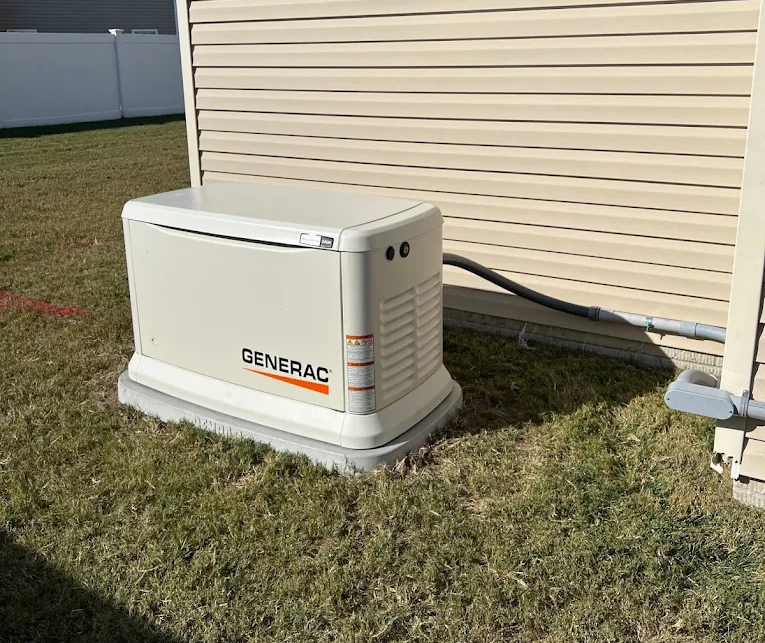
Hurricane season opens on June 1, and in Hampton Roads that date is the reason a standby generator gets looked at in spring rather than whenever. A generator that has sat through a winter of salt air and short weekly self-tests has quietly aged. The storm that finally asks it to run for three days is not the moment to find out how much. This checklist covers what you can look at yourself in April or May, what the yearly service adds, and the two items that matter more on the coast than anywhere else.
What you can check yourself
- Confirm the weekly self-test is happening. Note the day and time the unit is set to exercise, listen for it, and check the controller afterward. A generator that has stopped exercising will not start in a storm either.
- Read the controller’s status light and any message on its screen. Green means ready, yellow or amber means maintenance is due or a minor fault is logged, and red means a fault that will keep the unit from starting.
- Look at the enclosure from the outside for rust at the seams, damage to the finish, and debris against the louvers, and clear pine straw, leaves, and sand from around the base so air can move.
- Look around the pad for oil or coolant stains, which mean a leak that a long run will turn into an engine problem.
- If the unit runs on propane, read the tank gauge and arrange a fill if it is below half, since a tank that carried you through a winter storm may not carry you through a summer one.
- Confirm the gas or propane shutoff valve is open and that nothing has been stored or planted in the required clear space around the unit.
What the yearly service adds
The items above tell you the generator is alive. The service visit tells you it will run for days when you need it. The technician tests the battery under load, which is the only way to know whether it will turn a cold engine, and replaces it if it is past two to four years. The oil and oil filter are changed, the air filter and spark plugs are replaced as needed, and the fuel pressure and regulator are checked, since a regulator that has drifted produces a generator that starts and then surges or stalls under load. The transfer switch is inspected and its contacts checked, every electrical connection is cleaned and tightened, the controller’s fault history is read, and the unit is run under a full load rather than the light load of a self-test, which is the test that shows whether it will carry the house.
The two coastal items
Salt is the first. It settles on battery terminals, controller connections, and the transfer switch contacts as a film that raises resistance, and it pits the enclosure wherever the finish has been scratched. A coastal service visit cleans the terminals and connections, treats them against corrosion, and touches up the cabinet, and a unit that skips a year here shows it faster than an inland one. Pests are the second. A generator enclosure is warm, dry, and out of the weather, which makes it a favored winter home for mice and wasps, and their nests foul the controller and the air intake. The visit includes opening the cabinet and looking, which is not something most homeowners want to do themselves.
Sizing and load, while the technician is there
Spring is also the moment to ask whether the generator still fits the house. A heat pump replaced since the generator was installed may draw more than the unit was sized for, and a new electric vehicle charger or a pool pump adds load the original calculation never saw. The technician can total the current loads from the equipment nameplates and tell you whether the unit will still carry them, or whether a load management module that sheds the heat strips when the generator nears capacity would let it. Our generator service visits include that review.
If you rely on a portable generator
A portable unit needs its own spring routine. Drain or treat the fuel that sat over the winter, since stale gasoline in the carburetor is the usual reason a portable refuses to start, and run the unit for fifteen minutes under a small load. Check the oil, replace the spark plug if it has been a few seasons, and confirm the cords you plan to use are outdoor rated and undamaged. If the unit connects to the house through a manual transfer switch, test the switch. And please plan now where the unit will run when the time comes, well away from windows and doors, because carbon monoxide from portable generators takes lives every storm season.
Keeping it on the calendar
The Generator Care Agreement covers the yearly service and takes 20 percent off service and diagnostic fees and 15 percent off parts and labor on repairs, which is a sensible arrangement for equipment that only has to work on the worst day of the year. Russell’s American Mechanical has served Hampton Roads since 1977 and installs and services standby generators across the region. Schedule the spring visit online, through the website chat, or by phone, and the best time to do it is before the first named storm is on the map.
