
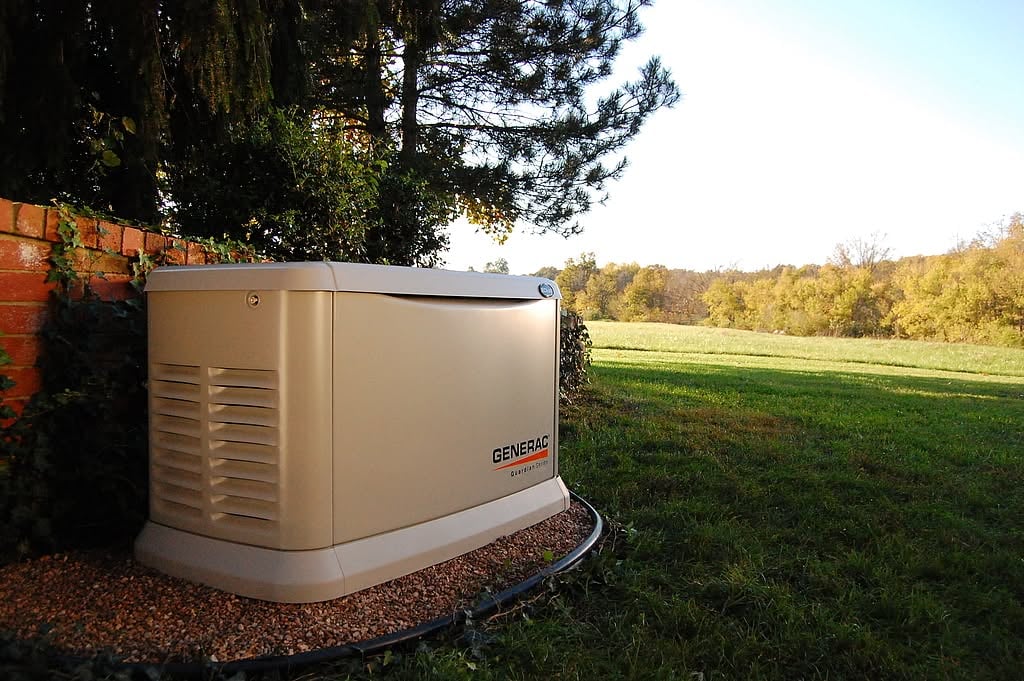
Shopping for a generator means working through categories before you ever reach a specific model: portable or standby, gasoline or propane or natural gas, air-cooled or liquid-cooled, and then a list of features that varies from one manufacturer to the next. The right answer depends on what your home needs to keep running during an outage and for how long. In Hampton Roads it also depends on salt air, flooding, and the heat pumps most homes rely on. This post walks through the options in the order you will meet them. When a technician later recommends a particular unit, the reasoning should be clear.
Portable or standby
A portable generator sits on wheels, and when the power fails you roll it out, fuel it, start it, and connect it. It costs less and suits a household that wants a refrigerator, some lights, and a few devices running through a short outage. Its drawbacks are that it needs an operator, wants fuel every several hours, cannot carry central heating or cooling in most homes, and gives off carbon monoxide that must stay well clear of the house. A standby generator is permanently installed outside, connected to the panel through an automatic transfer switch, and fueled by natural gas or propane. It starts on its own within seconds of an outage and shuts down when the utility returns, whether or not anyone is home, and it is the option that keeps a coastal house cool through an August outage and warm through an ice storm.
Within portables: conventional and inverter
Portable units come in two designs. Conventional portables are the familiar loud units with an engine running at constant speed, and they deliver more watts per dollar for pumps, lights, and refrigerators. Inverter generators run at variable speed, are far quieter, sip fuel at low loads, and produce cleaner power that is safer for laptops, televisions, and other electronics. Many portables now run on either gasoline or propane, which matters here because gasoline is scarce during a regional outage and goes stale in storage, while propane keeps indefinitely.
Within standbys: air-cooled and liquid-cooled
Standby units are sorted by how the engine is cooled. Air-cooled units, covering roughly 10 to 26 kilowatts, are the standard choice for most homes; they are compact, cost less, and carry a typical house including air conditioning when sized correctly. Liquid-cooled units start around 22 kilowatts and go much higher, with a radiator like a car engine, quieter operation, and better tolerance for long continuous runs. They are chosen for large homes, for homes with heavy loads such as multiple cooling systems or a pool, and for homes where the heat pump’s auxiliary heat strips push the load past what an air-cooled unit handles. In Hampton Roads, the heat strip load is the factor that most often moves a home from one category to the other.
Fuel: natural gas, propane, and dual fuel
A standby unit on natural gas never needs refueling and runs as long as the gas utility does, and natural gas service reaches many neighborhoods across Chesapeake, Virginia Beach, and Norfolk. Homes without it use propane from a tank on the property, which works just as well but adds the tank, the refill schedule, and the question of how many days of fuel the tank holds. Portable units run on gasoline, propane, or both. If your home has natural gas service, that usually settles the fuel question for a standby generator; if not, the propane tank becomes part of the installation plan and the technician sizes it for the run time you want.
Features that matter on the coast
Once the category and fuel are settled, models differ in ways that matter over the life of the unit, and a few of those ways matter more here. Enclosure material comes first: aluminum resists the corrosion that Hampton Roads salt air works on steel over the years, and it earns its cost. Mounting height comes next, since in flood-prone areas the unit belongs on an elevated pad above the level storm surge and tidal flooding reach. Wi-Fi monitoring puts the generator’s status, its exercise history, and any fault codes on your phone, which is how many owners learn a unit needs service before an outage makes the point. Load management modules let a smaller generator run a larger home by shedding big loads such as heat strips when the unit is near capacity. Sound rating matters near a bedroom window or a neighbor. Warranty terms run from about five years to ten depending on the manufacturer and whether an extended warranty is purchased, and the availability of parts and trained service nearby matters more than any brochure feature.
What the sizing visit adds
None of the categories above says which unit your home needs. That comes from a load calculation, in which a technician totals the running and starting loads of the equipment in your house from the nameplates, including the heat pump and its strips, the water heater, the well or sump pump, and the appliances you want to keep running. The result is a kilowatt figure that narrows the field. Because Russell’s American Mechanical handles the electrical work as well as the generator, the same visit covers the transfer switch and any panel capacity the generator needs. Our generator installation consultations produce that figure and a firm price at everyday pricing for the recommended unit, the switch, and the fuel connection, with financing available, and the Generator Care Agreement covers the yearly service afterward.
A recommendation for your home rather than a catalog
Russell’s American Mechanical has served Hampton Roads since 1977 and installs and services standby generators across the region. If you are weighing the options, schedule a consultation online, through the website chat, or by phone. The technician will walk through your outage history, your household’s needs, and your equipment, and recommend a specific make and model with the reasons behind it, rather than leaving you to choose from a list.
