
The power went out, or the lights flickered during a storm, and everything seems fine now, and often it is. Sometimes, though, an outage or a surge has damaged something that will not fail for weeks, by which time the storm is forgotten. Knowing which systems are vulnerable, and what each does when it has been hurt, lets you catch the damage while it is still a small repair. Here are the systems in a Hampton Roads home most often affected, what an outage or surge does to each, and the sign to watch for.
How outages and surges do their damage
The two events harm equipment differently. An outage itself is mostly harmless; the damage comes at the edges, when power flickers during restoration or returns at low voltage for a few minutes. Motors that start and stop repeatedly overheat, and a compressor that restarts against pressure it has not had time to release is strained every time. A surge is a brief voltage spike, from lightning nearby, from the utility switching the grid back on, or from a large motor starting inside the house, and it damages the electronics in nearly every appliance. Unfortunately, coastal storms deliver both at once.
Heating and cooling equipment
The air conditioner or heat pump is the most expensive thing an outage can hurt and the one that fails most often after. The restart is the risk: a compressor that stops and is asked to start again within seconds works against high pressure, and repeated flickers do that over and over. Surges take out the capacitor, the contactor, and the control board, and a low-voltage return can burn out a blower motor. The signs are a system that hums without starting, a system that runs but never cools, a repeating click at the outdoor unit, or a thermostat that has gone blank. Any of these after an outage is a reason for a visit, and the repair is a small part today and a compressor if the strained unit keeps trying.
The water heater
An electric water heater’s elements and thermostats are vulnerable to surges, and its high-limit reset trips after a power event in some units, so no hot water an hour after restoration is a common call. A tankless unit, gas or electric, has a control board that surges damage, and it will show an error code or simply not fire. Pressure swings during an outage can also turn a small drip at the base of an old tank into a visible leak, so the floor around the heater is worth a look. Our water heater team handles each of these, and a heater that took a surge often needs only a board or an element rather than replacement.
The generator and the transfer switch
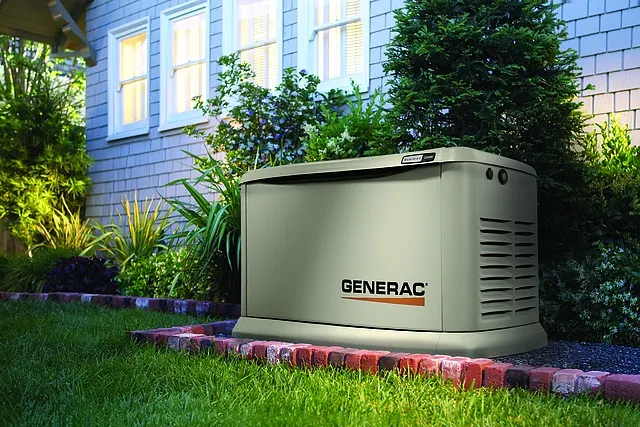
A standby generator is built for outages, but the transfer switch that connects it is the component a surge reaches first, since it sits between the utility and the house. A switch with damaged contacts may fail to return the house to utility power when it comes back, or fail to hand off to the generator next time. The signs are a generator that starts but the house stays dark, a controller fault after the outage, or utility power restored while the generator keeps running. A generator service visit after a long outage checks the switch along with the engine.
The panel and the wiring
A large surge can damage breakers so that they no longer trip when they should, which is the dangerous direction to fail, and it can scorch bus bar connections inside the panel. The signs are subtle: a burning smell at the panel, a breaker that feels warm, buzzing, or a breaker that will not reset or resets but no longer trips under an obvious overload. Older panels across Norfolk, Portsmouth, and Chesapeake tolerate surges poorly, and a post-storm electrical inspection that opens the panel is the only way to know what happened inside it.
Appliances and smart devices
Refrigerators, washers, dryers, dishwashers, and ranges all carry control boards now, and a surge that spares the motor can leave the board dead or erratic. A refrigerator that runs constantly, a dishwasher that stops mid-cycle, or a washer with a blank display in the week after a storm is a surge casualty. Smart thermostats, doorbells, garage door openers, and routers are the most sensitive of all, and their failure is often the first sign a surge came through, so the heating and cooling system and the panel should be looked at too.
Sensitive electronics
Televisions, computers, and audio equipment are what most people think of first, and they are the easiest to protect with a point-of-use surge strip. A strip that has absorbed a large surge has often spent itself doing so, its indicator light will show that, and it protects nothing afterward.
What to do in the week after
- Walk the house and note anything not working the way it did before the storm, including small things such as a thermostat that lost its schedule.
- Listen to the heating and cooling system start, and call if it hums, clicks, or runs without cooling.
- Check the water heater for hot water and for moisture at its base.
- Look at the panel for tripped breakers and notice any warmth, smell, or sound there.
- If several electronics died at once, assume a surge reached the panel and have it inspected.
Preventing the next one
Nearly all of the damage above is preventable, and our post on protecting your electronics and HVAC from power surges covers how: whole-home surge protection at the panel, point-of-use protection for electronics, sound grounding, and periodic inspection. Russell’s American Mechanical has served Hampton Roads since 1977 with electrical, heating, cooling, plumbing, and generators under one roof, which after a storm means one visit can look at everything on this list. Book it online, through the website chat, or by phone; same-day appointments are available by phone when the day allows.